๐Ÿ” Spring Authentication Workflow

Interactive Deep Dive for Engineering Students

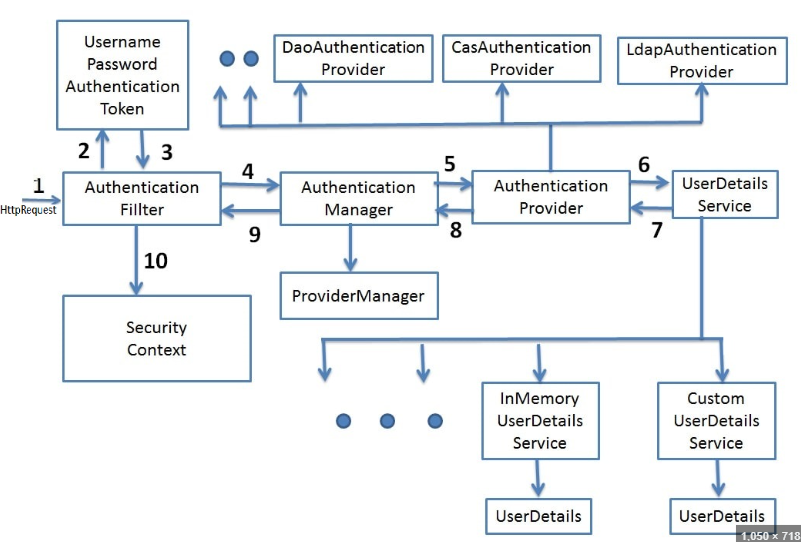
๐Ÿ“‹ Authentication Workflow Overview

โ–ผ

Spring Security's authentication workflow is a sophisticated process that involves multiple components working together to verify user credentials and establish security context.

1. Authentication Request

User submits credentials (username/password) through login form or API

โ†“

2. AuthenticationManager

Central coordinator that delegates authentication to appropriate providers

โ†“

3. AuthenticationProvider

Handles specific authentication mechanisms (DB, LDAP, OAuth, etc.)

โ†“

4. UserDetailsService

Loads user information from various data sources

โ†“

5. Authentication Result

Returns authenticated principal or throws exception

๐ŸŽฎ Interactive Flow Simulation

Click "Start Authentication Flow" to see the process in action...

๐ŸŽฏ AuthenticationManager

โ–ผ

The AuthenticationManager is the main interface for authentication in Spring Security. It's responsible for coordinating the authentication process.

Authentication authenticate(Authentication authentication) throws AuthenticationException

๐Ÿ”ง Core Responsibility

Acts as the central coordinator for authentication. It doesn't perform authentication itself but delegates to registered AuthenticationProviders.

๐Ÿ—๏ธ Implementation

Most commonly implemented by ProviderManager, which maintains a list of AuthenticationProviders and tries each one until success or all fail.

โšก Key Features

Supports authentication erasure, parent authentication managers, and authentication event publishing.

@Component
public class CustomAuthenticationManager implements AuthenticationManager {
    
    @Autowired
    private List<AuthenticationProvider> providers;
    
    @Override
    public Authentication authenticate(Authentication authentication) 
            throws AuthenticationException {
        
        for (AuthenticationProvider provider : providers) {
            if (provider.supports(authentication.getClass())) {
                try {
                    Authentication result = provider.authenticate(authentication);
                    if (result != null) {
                        return result;
                    }
                } catch (AuthenticationException e) {
                    // Log and continue to next provider
                    lastException = e;
                }
            }
        }
        
        throw new ProviderNotFoundException("No suitable provider found");
    }
}
                

๐Ÿงช AuthenticationManager Demo

๐Ÿ” AuthenticationProvider

โ–ผ

The AuthenticationProvider interface defines the contract for authentication providers that handle specific authentication mechanisms.

Authentication authenticate(Authentication authentication) throws AuthenticationException

boolean supports(Class<?> authentication)

๐ŸŽญ authenticate() Method

Performs the actual authentication logic. Returns a fully authenticated Authentication object with credentials cleared, or null if the provider cannot authenticate.

โœ… supports() Method

Determines whether this provider can handle the given Authentication type. This allows for multiple providers handling different authentication mechanisms.

๐Ÿ”„ Common Implementations

DaoAuthenticationProvider (database), LdapAuthenticationProvider (LDAP), JwtAuthenticationProvider (JWT tokens), etc.

@Component
public class CustomDaoAuthenticationProvider implements AuthenticationProvider {
    
    @Autowired
    private UserDetailsService userDetailsService;
    
    @Autowired
    private PasswordEncoder passwordEncoder;
    
    @Override
    public Authentication authenticate(Authentication authentication) 
            throws AuthenticationException {
        
        String username = authentication.getName();
        String password = authentication.getCredentials().toString();
        
        // Load user details
        UserDetails userDetails = userDetailsService.loadUserByUsername(username);
        
        // Verify password
        if (!passwordEncoder.matches(password, userDetails.getPassword())) {
            throw new BadCredentialsException("Invalid credentials");
        }
        
        // Create successful authentication
        return new UsernamePasswordAuthenticationToken(
            userDetails, null, userDetails.getAuthorities());
    }
    
    @Override
    public boolean supports(Class<?> authentication) {
        return UsernamePasswordAuthenticationToken.class.isAssignableFrom(authentication);
    }
}
                

๐Ÿ”ฌ Provider Methods Demo

1
2
3
4

๐Ÿ‘ค UserDetailsService

โ–ผ

The UserDetailsService is a core interface that defines how to retrieve user information. It provides an abstraction layer over different user identity stores.

UserDetails loadUserByUsername(String username) throws UsernameNotFoundException

๐ŸŽฏ Primary Purpose

Provides a standard way to load user-specific data during authentication. It's the bridge between Spring Security and your user data source.

๐Ÿ”„ Data Source Abstraction

Can load users from databases, LDAP, memory, web services, or any custom source. Implementation details are hidden behind this interface.

๐Ÿ“Š UserDetails Contract

Returns UserDetails object containing username, password, authorities, and account status flags (enabled, expired, locked).

@Service
public class CustomUserDetailsService implements UserDetailsService {
    
    @Autowired
    private UserRepository userRepository;
    
    @Override
    public UserDetails loadUserByUsername(String username) 
            throws UsernameNotFoundException {
        
        // Fetch user from database
        User user = userRepository.findByUsername(username)
            .orElseThrow(() -> new UsernameNotFoundException(
                "User not found: " + username));
        
        // Convert to Spring Security UserDetails
        return org.springframework.security.core.userdetails.User.builder()
            .username(user.getUsername())
            .password(user.getPassword())
            .authorities(user.getRoles().stream()
                .map(role -> new SimpleGrantedAuthority("ROLE_" + role.getName()))
                .collect(Collectors.toList()))
            .accountExpired(!user.isAccountNonExpired())
            .accountLocked(!user.isAccountNonLocked())
            .credentialsExpired(!user.isCredentialsNonExpired())
            .disabled(!user.isEnabled())
            .build();
    }
}
                

๐ŸŽช UserDetailsService Demo

// Custom UserDetails implementation
public class CustomUserDetails implements UserDetails {
    private String username;
    private String password;
    private List<GrantedAuthority> authorities;
    private boolean enabled;
    private boolean accountNonExpired;
    private boolean credentialsNonExpired;
    private boolean accountNonLocked;
    
    // Constructor and getters...
    
    @Override
    public Collection<? extends GrantedAuthority> getAuthorities() {
        return authorities;
    }
    
    @Override
    public boolean isEnabled() {
        return enabled;
    }
    
    // Other UserDetails methods...
}
                

๐Ÿ”— Complete Integration Example

โ–ผ

Here's how all components work together in a complete Spring Security configuration:

๐Ÿ“Œ Diagram inspired by JavaInUse Spring Security JWT Series (Chapter 3)

@Configuration
@EnableWebSecurity
public class SecurityConfig {
    
    @Autowired
    private CustomUserDetailsService userDetailsService;
    
    @Bean
    public AuthenticationManager authenticationManager(
            AuthenticationConfiguration config) throws Exception {
        return config.getAuthenticationManager();
    }
    
    @Bean
    public AuthenticationProvider authenticationProvider() {
        DaoAuthenticationProvider provider = new DaoAuthenticationProvider();
        provider.setUserDetailsService(userDetailsService);
        provider.setPasswordEncoder(passwordEncoder());
        return provider;
    }
    
    @Bean
    public PasswordEncoder passwordEncoder() {
        return new BCryptPasswordEncoder();
    }
    
    @Bean
    public SecurityFilterChain filterChain(HttpSecurity http) throws Exception {
        http
            .authorizeHttpRequests(auth -> auth
                .requestMatchers("/login", "/register").permitAll()
                .anyRequest().authenticated()
            )
            .formLogin(form -> form
                .loginPage("/login")
                .defaultSuccessUrl("/dashboard")
            )
            .authenticationProvider(authenticationProvider());
        
        return http.build();
    }
}
                

๐ŸŽฏ Complete Flow Demonstration